Learn How to Care For Your Teeth From Orthodontics Specialists
As orthodontics specialists, we can straighten your teeth and transform your smile. Orthodontic treatment is often necessary to straighten your teeth and to prevent decay in hard to reach areas like overcrowded teeth. Straightening treatments should be a priority for you and your loved ones in order to ensure long-term oral health. A beautiful smile can result from having teeth straightened using braces or aligners. Many people are so distracted by their straightening process that they often forget the importance of keeping their teeth clean during the alignment process. Here are some ways that you can care for your teeth during an orthodontics treatment.
No matter what form of dental straightening a patient chooses, whether it is an aligner or traditional braces, there are certain cleaning guidelines to keep in mind. Patients will not only want to keep the teeth stain-free but will also want to prevent decay. Aligners may be easier when it comes to cleaning teeth, but many people assume their chances of decay are less with aligners which are not true.
Flossing
Flossing with braces can be challenging. Sometimes it can be helpful to use products like a Waterpik, which uses a water stream to rinse between teeth. As orthodontics specialists, we can also provide patients with tools to try. Traditional flossing, however, is hard to beat, which is why one needs to also attempt normal flossing methods. With braces, patients can stick one end of the floss through the crease between the teeth above the top wire of the braces. After this, grab both ends and gently pull back and forth. Repeat this process with all of the teeth. During this process, do not pull down on the wires as this can bend them out of shape. During the orthodontics treatment, flossing will be easier if one does not eat sticky foods or things that have the potential to get lodged in the teeth, like popcorn kernel shells.
With an aligner, flossing is much easier. Patients simply remove the aligner whenever they want to floss. While wearing aligners, it can be helpful to floss after each meal before placing the aligner back on the teeth. This will prevent bacteria build-up, gum disease and decay by removing food particles.
Brushing
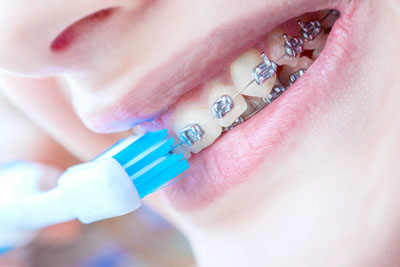
Brushing one's teeth is slightly easier than flossing during orthodontics treatment, but it can still be tricky to get the best clean possible. For traditional braces, there are special brushes a patient can get that is angled. Thus, patients can reach from above and below to brush hard to reach areas. After using this special brush also referred to as a proxy brush, patients should use a classic toothbrush with fluoride toothpaste to ensure they attain an all-over clean. After rinsing thoroughly, patients can use mouthwash for good measure.
With an aligner, patients just remove the aligner and brush with a normal toothbrush and fluoride toothpaste after every meal. Patients also need to continue regular brushing every morning and night. During this time, it is important also to clean the aligner so that bacteria does not build up, and grime does not stain the clear plastic material. The use of mouthwash is also important after brushing, but do not use it to clean the aligner.
As meticulous as it can be to care for your teeth during an orthodontics treatment, it is vital to ensure you do not experience any dental decay or staining that can counter your current correction method. As orthodontic specialists, we can help you to keep your teeth clean and healthy so that your smile is truly stunning when your treatment is complete.
A bright, confident smile can leave a lasting impression, and dental Lumineers® offers a simple way to achieve a beautiful look. These ultra-thin veneers provide a non-invasive solution for improving the appearance of teeth without extensive dental work. Many choose this treatment to correct discoloration, minor misalignment, or other cosmetic concerns.Lumineers are a type of…
Going to the dentist is a common fear, especially for patients new to dental care. A family dentist can accommodate anxious patients, regardless of whether these feelings stem from the fear of the unknown, pain from sensitive teeth, or the experience as a whole. Learning about these accommodations ahead of time can help a patient…
A family dentist is essential in maintaining and improving the oral health of patients at all stages of life. One of the critical services a family dentist provides is replacing missing teeth. Whether due to injury, decay, or other factors, missing teeth can significantly impact both the function and appearance of a smile. Fortunately, these…
It takes consistent care to maintain healthy teeth. Regular visits with a family dentist can prevent cavities and gum disease. These appointments can also identify issues in their early stages and promote lifelong wellness for people of all ages.Cavities often begin as small areas of decay. When left untreated, they can develop into large cavities…
 As
As